


From centrosymmetric CN3H6C6H5SO3 to non-centrosymmetric CN3H6C6H4SO3(OH): Hydroxyl introduced hydrogen bond reconstruction to realize strong second harmonic generation
Xiaodong Zhang, Bohui Xu, Deshuai Xiao, Xinyuan Zhang, Pifu Gong*, Zheshuai Lin*
Chin. J. Struct. Chem., 2025, 44(10), 100707. DOI: 10.1016/j.cjsc.2025.100707
October 15, 2025
ABSTRACT
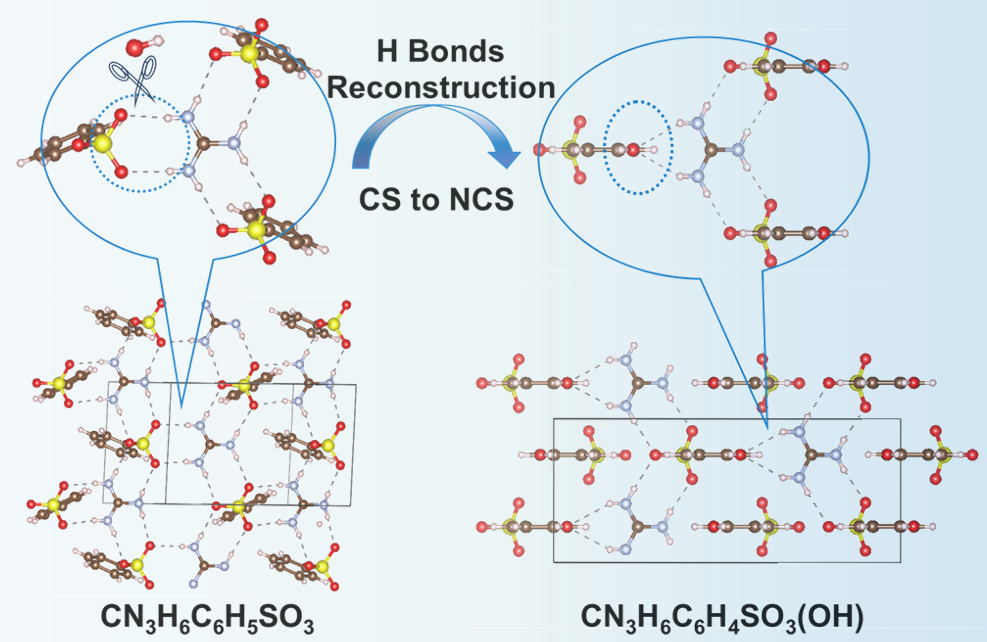
Non-centrosymmetric (NCS) crystalline structures, critical for second harmonic generation (SHG) in all-solid-state lasers, are far less prevalent than their centrosymmetric (CS) counterparts. In this study, we report a structural transformation from CS to NCS configuration in benzenesulfonate derivatives via hydroxyl group incorporation, as illustrated by the transition in the newly discovered CN3H6C6H5SO3 (CS) and CN3H6C6H4SO3(OH) (NCS). The introduced hydroxyl groups induce hydrogen bond reconstruction, effectively breaking the original centrosymmetry. The resulting NCS compound exhibits remarkable nonlinear optical (NLO) properties, including a strong SHG response (1.6 × KDP with the particle sizes of 200-250 um), a wide bandgap (UV cutoff at 290 nm, corresponding band gap is 4.37 eV), and a large birefringence (0.21@1064nm), demonstrating excellent potential as an UV NLO crystal material.




- Address: Fuzhou High & New Technology Industrial Zone, Shangjie, Minhou, Fuzhou, Fujian 350108, China
- Tel: (86)-591-63173769, 63173770
- E-mail: cjsc@fjirsm.ac.cn
CN 35–1112/TQ, ISSN 0254–5861, Online ISSN: 2949-768X Copyright @ 2022 Chinese Journal of Structural Chemistry-www.Chinese Journal of Structural Chemistry.net. All Rights Reserved 闽ICP备2022002645号-1