


Cover Picture
Development of a theranostic tri-nuclear gadolinium(III) complex based on apoferritin for multitarget therapy of orthotopic glioma
Xueyu Man, Guochao Li, Minghui Zhu, Shanhe Li, Gang Xu, Zhenlei Zhang*, Hong Liang, Feng Yang* Submit a Manuscript
Development of a theranostic tri-nuclear gadolinium(III) complex based on apoferritin for multitarget therapy of orthotopic glioma
Xueyu Man, Guochao Li, Minghui Zhu, Shanhe Li, Gang Xu, Zhenlei Zhang*, Hong Liang, Feng Yang* Submit a Manuscript
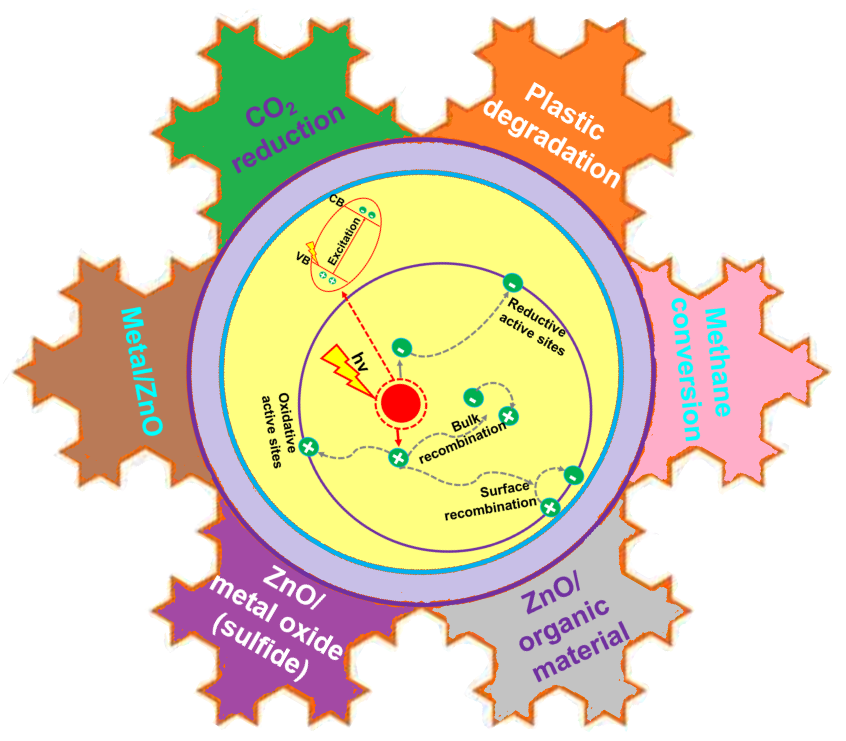
Unlocking the engineering of solar-driven ZnO composites: From fundaments to sustainable and eco-friendly chemical energy
Irshad Ahmad, Yifei Zhang, Ayman Al-Qattan, S. AlFaify, Gao Li*
Chin. J. Struct. Chem., 2025, 44(11), 100700. DOI: 10.1016/j.cjsc.2025.100700
November 1, 2025
ABSTRACT
Plastic pollution and elevated atmospheric CO2 levels remain critical environmental challenges, whereas methane is increasingly recognized as a valuable feedstock for producing high-value chemicals. Photocatalysis offers a promising approach to harness abundant solar energy, converting it into sustainable and eco-friendly chemical energy for applications such as plastic degradation, CO2 reduction, and methane oxidation. ZnO-based composites stand out due to their large surface areas, tunable band structures, and abundant active sites, making them highly suitable for these photocatalytic processes. Nonetheless, pure ZnO is hindered by rapid recombination of photoinduced e-/h+ pairs and limited absorption of visible light, restricting its photocatalytic efficiency. This review explores the fundamental mechanisms, synthesis strategies, and various ZnO-based composite materials that enhance photocatalytic plastic degradation, CO2 conversion, and methane oxidation. Special attention is given to identifying key challenges and how the formation of ZnO composites addresses these issues within the different catalytic reaction pathways to improve overall photocatalytic activity. Finally, existing challenges and prospective research avenues are discussed to guide future advancements.




- Address: Fuzhou High & New Technology Industrial Zone, Shangjie, Minhou, Fuzhou, Fujian 350108, China
- Tel: (86)-591-63173769, 63173770
- E-mail: cjsc@fjirsm.ac.cn
CN 35–1112/TQ, ISSN 0254–5861, Online ISSN: 2949-768X Copyright @ 2022 Chinese Journal of Structural Chemistry-www.Chinese Journal of Structural Chemistry.net. All Rights Reserved 闽ICP备2022002645号-1