


Cover Picture
Development of a theranostic tri-nuclear gadolinium(III) complex based on apoferritin for multitarget therapy of orthotopic glioma
Xueyu Man, Guochao Li, Minghui Zhu, Shanhe Li, Gang Xu, Zhenlei Zhang*, Hong Liang, Feng Yang* Submit a Manuscript
Development of a theranostic tri-nuclear gadolinium(III) complex based on apoferritin for multitarget therapy of orthotopic glioma
Xueyu Man, Guochao Li, Minghui Zhu, Shanhe Li, Gang Xu, Zhenlei Zhang*, Hong Liang, Feng Yang* Submit a Manuscript
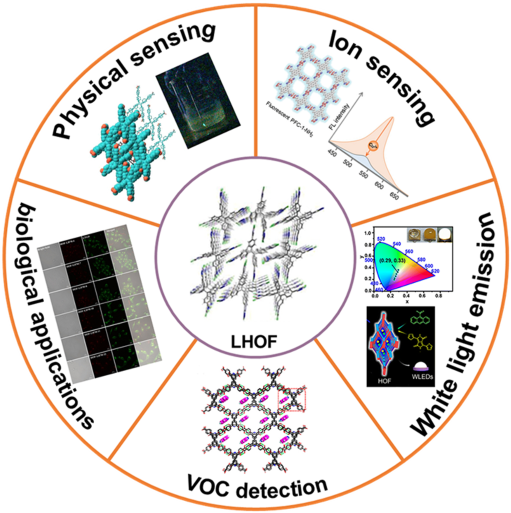
Luminescent hydrogen-bonded organic frameworks: From design to applications
Longhao Hu, Lingshan Gong, Wenlong Ye, Hao Chen, Xiao-Li Lai, Yingxiang Ye*
Chin. J. Struct. Chem., 2025, 44(11), 100703. DOI: 10.1016/j.cjsc.2025.100703
November 1, 2025
Hydrogen-bonded organic frameworks; Luminescent materials; Sensing; White-light emission; Bioimaging
ABSTRACT
Hydrogen-bonded organic frameworks (HOFs) represent an innovative category of crystalline porous materials, formed through the self-assembly of organic building blocks via intermolecular hydrogen bonds, along with supplementary interactions such as π-π stacking and van der Waals forces. The relatively weak nature of hydrogen bonding endows HOFs with remarkable structural flexibility and a wide range of functional potential. Among them, luminescent HOFs (LHOFs) not only preserve the inherent luminescent properties of their organic fluorophore components but also exhibit key features characteristic of HOF materials, including porosity, recyclability, solution processability, and exceptional biocompatibility. This review outlines the design principles of LHOFs and explores their most recent applications, such as in sensing, bioimaging, and white-light emission. Lastly, we discuss current challenges and provide an outlook on future research directions in this field.




- Address: Fuzhou High & New Technology Industrial Zone, Shangjie, Minhou, Fuzhou, Fujian 350108, China
- Tel: (86)-591-63173769, 63173770
- E-mail: cjsc@fjirsm.ac.cn
CN 35–1112/TQ, ISSN 0254–5861, Online ISSN: 2949-768X Copyright @ 2022 Chinese Journal of Structural Chemistry-www.Chinese Journal of Structural Chemistry.net. All Rights Reserved 闽ICP备2022002645号-1