


Cover Picture
Development of a theranostic tri-nuclear gadolinium(III) complex based on apoferritin for multitarget therapy of orthotopic glioma
Xueyu Man, Guochao Li, Minghui Zhu, Shanhe Li, Gang Xu, Zhenlei Zhang*, Hong Liang, Feng Yang* Submit a Manuscript
Development of a theranostic tri-nuclear gadolinium(III) complex based on apoferritin for multitarget therapy of orthotopic glioma
Xueyu Man, Guochao Li, Minghui Zhu, Shanhe Li, Gang Xu, Zhenlei Zhang*, Hong Liang, Feng Yang* Submit a Manuscript
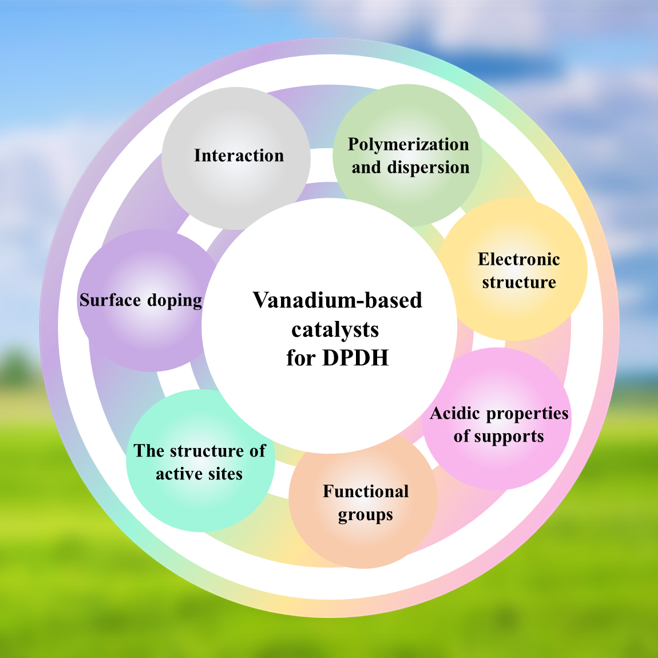
Vanadium-based catalysts for propane direct dehydrogenation to propylene: Modification strategies and research direction
Manqi Zhao, Heting Hou*, Dehua He, Huimin Liu, Shaoyuan Sun, Dezheng Li*, Chao Wang, Yiming Lei*
Chin. J. Struct. Chem., 2025, 44(11), 100709. DOI: 10.1016/j.cjsc.2025.100709
November 1, 2025
Direct propane dehydrogenation; Vanadium-based catalysts; Modification strategies; Catalysis
ABSTRACT
Direct propane dehydrogenation (DPDH) represents a highly attractive route for on-purpose propylene production, a key building block in the petrochemical industry. In particular, among various catalytic platforms, vanadium-based catalysts have emerged as promising candidates due to their tunable properties including redox ability, surface acidity, and Resistance to coking. Although the catalytic community has obtained great achievement in this area, how to promote vanadium-based catalysts towards the next step in DPDH applications like industrial-level implementations is still challenging. Moreover, there are still several controversial theories in our community, meaning it is necessary to clarify these indistinct points to pave the way for the next generation of research. Herein, the pivotal modification strategies of vanadium-based catalysts have been summarized via introducing representative works. In addition, the current unclear mechanism and research gaps, especially in the issues of deactivation and selectivity control, are also revealed so that the potential research directions are well-founded proposed. By integrating fundamental understanding and practical considerations, this review aims to inspire the further development of vanadium-based DPDH catalysts for in-depth academic research and next-generation industrial deployment.




- Address: Fuzhou High & New Technology Industrial Zone, Shangjie, Minhou, Fuzhou, Fujian 350108, China
- Tel: (86)-591-63173769, 63173770
- E-mail: cjsc@fjirsm.ac.cn
CN 35–1112/TQ, ISSN 0254–5861, Online ISSN: 2949-768X Copyright @ 2022 Chinese Journal of Structural Chemistry-www.Chinese Journal of Structural Chemistry.net. All Rights Reserved 闽ICP备2022002645号-1